Logo text We all have our television pet peeves and, for me, red flags abound in Peacock‘s new limited series, The Good Daughter.
Adapted by Karin Slaughter from her book of the same name, The Good Daughter is interchangeable, in terms of title, plot or structure, with a dozen recent limited series — most conspicuously, Amazon’s The Better Sister and Netflix’s His & Hers. The Good Daughter The Bottom Line A strong cast makes up for familiar irritations. Airdate: Thursday, November 12 (Peacock)Cast: Rose Byrne, Meghann Fahy, Brendan Gleeson, Olivia Williams, Harper Steele, Michael Dorman, Audrey Grace Marshall, Drew CheekCreator: Karin SlaughterDirector: Steph Green
It’s a story set in and filmed in the Deep South, but its central cast is populated by actors from Australia, Ireland, Massachusetts and basically anywhere other than the Deep South, leading to a succotash of colorful and, to put it politely, inconsistent accents. Related Stories TV 'O.J.'s Accomplice' Has Its Own 'The Jinx' Hot Mic Moment TV Matthew Weiner Out as Showrunner of Eddie Murphy Peacock Series After Clash With Producers
What Happened Behind the Scenes
And it’s a story instigated by a school shooting and pushed forward by multiple instances of sexual violence, all propping up a mystery that’s barely mysterious — at least until the characters all sit down to explain everything in a series of weakly staged monologues.
That The Good Daughter is so full of tropes I find tedious or annoying and yet somehow ends up being compulsively entertaining is a tribute to Slaughter’s gift for characterization and dialogue, the confident hand of series director Steph Green, and particularly the committed, emotionally exposed and often funny performances from leads Meghann Fahy, Rose Byrne and Brendan Gleeson.
The Good Daughter begins with a double dose of trauma, the better to winnow away squeamish viewers.
First, in flashback, devoted sisters Sam (Audrey Grace Marshall) and Charlie (Drew Cheek) witness a horrible act of violence perpetrated on their doting mother (Olivia Williams’ Gamma), perhaps the latest retaliation against their father (Gleeson’s Rusty), a defense attorney prone to rubbing people the wrong way.
Jump to the present. Charlie (Fahy) has grown up to follow in her father’s footsteps, working out of his ramshackle office in the same Georgia town populated by people who still hate him and don’t feel too kindly toward her. She’s separated from hubby Ben (Michael Dorman, endearingly normal in a show populated by broad portrayals) and making various self-destructive choices, including a one-night stand with Huck (Jake McDorman), whose ponytail and scruff let you know he’s a bad idea.
Charlie and Huck accidentally swap phones, which leads her to discover that he’s a high school teacher. In the process of returning his phone, she is present when Kelly (Shayna Benardo, an impressively grounding force) shows up and shoots and kills the well-liked principal and a freshman.
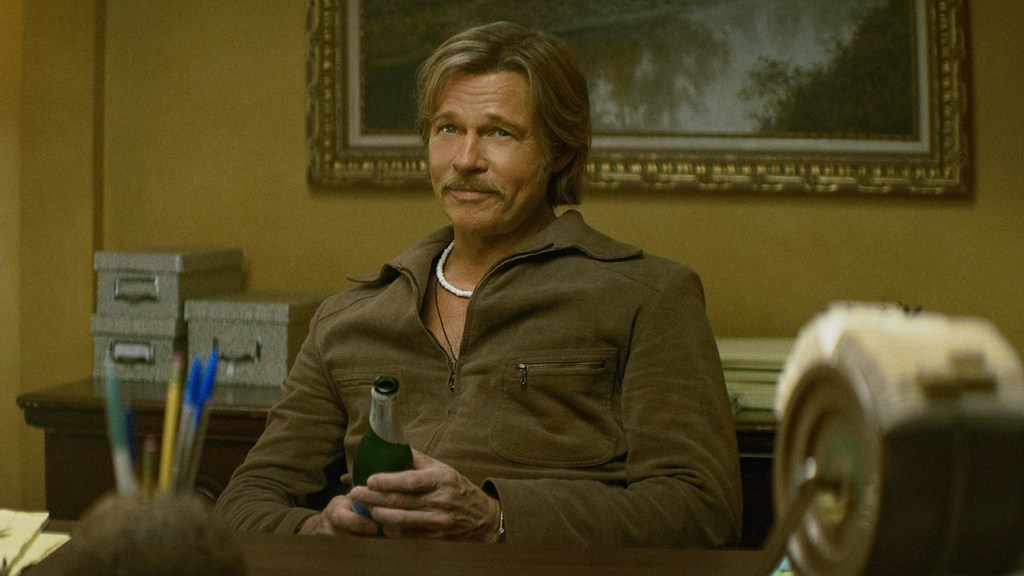
Rusty, who has a bad cough and a history of heart problems, and likes to wear — for reasons that are never explained — a red clown nose, shows up to represent Kelly, whose cognitive issues haven’t stopped the local powerbrokers from eyeing the death penalty.
Sensing everything is going astray, Rusty also calls elder daughter Sam (Byrne), now a patent lawyer in New York City and left with a permanent limp and partial blindness stemming from the incident with her mother. Sam hasn’t seen or talked to Charlie in 10 years, but she quickly finds herself back in Pikeville, caught up in the mystery of the shooting, as well as several additional mysteries from her family’s past.
If you just look at the bones of the series, The Good Daughter is beyond rudimentary, with a crime in the present and a crime in the past that just coincidentally happen to be directly connected. The story can barely even decide what twists are supposed to be surprising and, as a result, nothing is really “guessable” or revelatory.
Instead, The Good Daughter works best as a dirtied-up — though confusingly racially whitewashed — version of To Kill a Mockingbird, with Rusty as a lawyer doing noble things in a disreputable way, constantly looking like he slept at his desk, bottle in hand, eschewing Atticus Finch’s seersucker and moral rectitude. He stands up to threats from his adversaries that are violent and gory rather than ominous and insinuated, investigating cases in which the rape and persecution of the handicapped and impoverished play out on the surface rather than being buried in euphemism. It almost certainly works better on the page than on the screen, where we’ve seen too many versions of these generic rednecks in their generic pick-ups and these generic drawling, obfuscating lawmen to take them seriously.
Green and the series’ cinematographers are able to embed in the rundown streets of Pikeville and take us into the “holler,” capturing this community within a community. But when every main cast member talks like the closest they’ve ever been to a holler was a quick drive-through during rehearsal, the verisimilitude suffers.
What holds the show together is Slaughter’s grasp on the characters and their relationships. When Sam, Charlie and Rusty talk, it’s in a vernacular that mixes in-jokes, deeply felt family history, snooty literary references (lots of Flannery O’Connor and Emily Dickinson), amusingly unsnooty pop culture references (from Die Hard to Buffy the Vampire Slayer), and an awareness of how to hurt or heal the people they know best. Byrne, Fahy and Gleeson don’t talk like they come from the same place, but the energy among them gives the series its energy and its authenticity.
Sure, Fahy is doing a variation on her bad sister character from Netflix’s Sirens, but she’s tremendous at playing these open books of damage.
A little too much of Byrne’s performance consists of actorly takes on disability, but she makes those notes of artificiality pay off. Everything Sam does is a put-on; her attire, hair and speech are defined in opposition to the place she left behind and hoped never to return to, with aspects of her natural self returning as she spends more time in Pikeville.
It’s easy to buy them as sisters, in both the parts evoking pain and the parts where they bicker humorously. Plus, it’s easy to see the toll taken by trauma and time because Byrne and Fahy are well-matched by Marshall and Cheek.